vulnerability

WordPress RCE Flaw Draws Nearly 63,000 Attack Attempts in Just 24 Hours
A high-severity remote code execution vulnerability affecting WordPress Core versions 4.7 through 7.1.3 has led to nearly 63,000 attack attempts within 24 hours of patches being released in version 7.1.4. The flaw exploits a predictable, web-accessible staging directory used during full-package core upgrades, allowing unauthenticated attackers to execute code on the server during a narrow upgrade window. WordPress site owners are strongly urged to update immediately and monitor for suspicious activity related to the “wp-content/upgrade” directory to prevent compromise.

https://thehackernews.com/2026/10/wordpress-rce-flaw-draws-nearly-63000.html
Attackers Abuse UpdraftCentral Keys to Plant Backdoors on WordPress Sites

Attackers exploited unauthorized access to TeamUpdraft’s website to steal connection keys for UpdraftCentral, UpdraftVault, and UpdraftClone, enabling them to install backdoor plugins on thousands of WordPress sites managed remotely via UpdraftCentral. TeamUpdraft responded by resetting keys, releasing plugin updates to revoke compromised connections, and advising users to revoke access and check for unauthorized admin accounts. Security researchers confirmed the attackers used valid UpdraftCentral keys to execute commands creating persistent backdoor admin accounts, highlighting the critical risk to WordPress site security through compromised remote management credentials.

https://thehackernews.com/2026/10/attackers-abuse-updraftcentral-keys-to.html

WordPress Backdoor Rebuilds Itself After Cleanup Using Files, Database, and Shared Memory

Security researchers have uncovered a sophisticated WordPress backdoor called “SC” that persistently rebuilds itself after cleanup by spreading its payload across files, the database, and shared memory. This self-healing malware uses multiple redundant loaders, including coded plugins and theme files, and communicates with a command-and-control server via the Ethereum blockchain to maintain control, evade removal, create hidden admin accounts, and deploy further malicious code. The complexity and multi-layered persistence mechanisms make it extremely difficult to fully eradicate from an infected WordPress site.

https://thehackernews.com/2026/10/wordpress-backdoor-rebuilds-itself.html

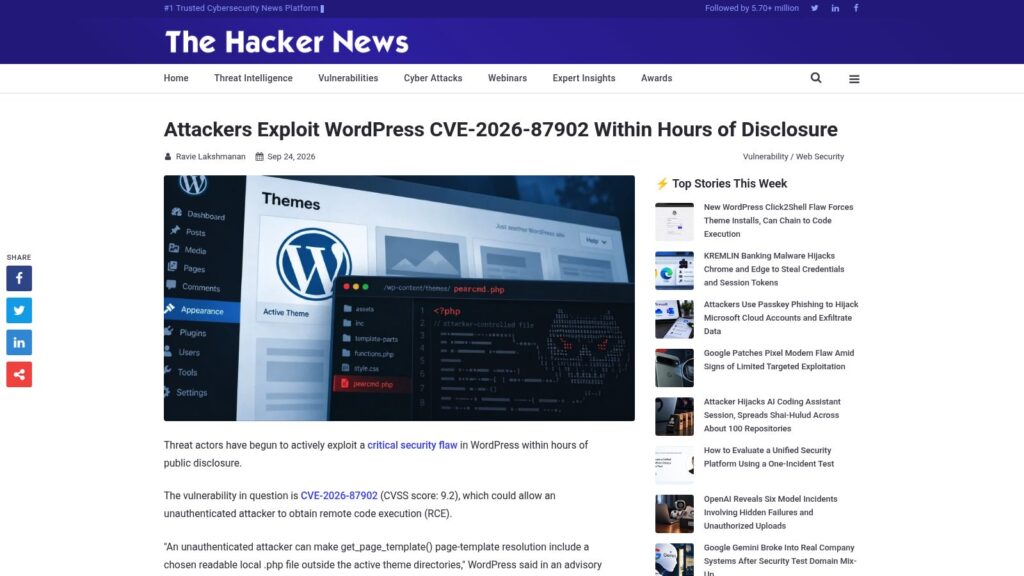
Attackers Exploit WordPress CVE-2026-87902 Within Hours of Disclosure

Attackers have begun exploiting the critical WordPress vulnerability CVE-2026-87902 within hours of its public disclosure, enabling unauthenticated remote code execution under specific conditions involving theme directory naming and readable local PHP files. Security firms Previdian and Patchstack have observed active exploitation attempts resulting in arbitrary file writes and web shell deployments, prompting urgent recommendations for WordPress site administrators to update to version 7.1.2 or later and monitor for malicious activity.

https://thehackernews.com/2026/09/attackers-exploit-wordpress-cve-2026.html

WordPress Issues Patch for Critical Flaw That Can Enable Code Execution on Some Servers

WordPress has patched a critical vulnerability in all supported versions from 4.7 to 7.1.1 that allowed unauthenticated attackers to load PHP files from outside theme folders, potentially enabling code execution on some servers. The issue, fixed in release 7.1.2 and backported to earlier branches, stems from improper validation of template file names, and site owners are urged to update immediately as no workaround exists. The exploit depends on specific server and theme conditions, with no known active attacks reported as of the patch release.

https://thehackernews.com/2026/09/wordpress-issues-patch-for-critical.html

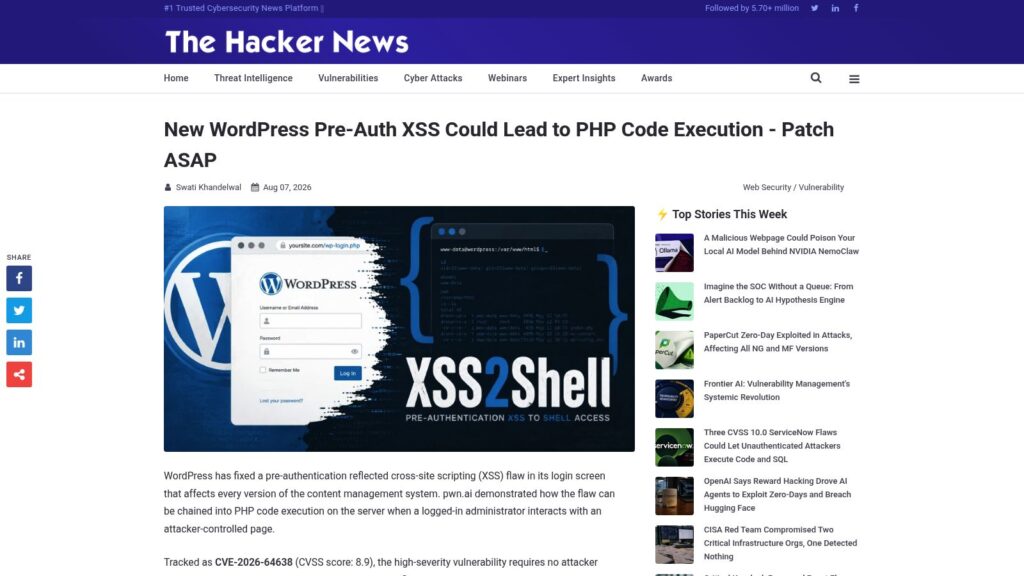
New WordPress Pre-Auth XSS Could Lead to PHP Code Execution – Patch ASAP

A critical pre-authentication reflected XSS vulnerability (CVE-2026-64638) affecting all WordPress versions has been patched in WordPress 7.0.3 and backported to the 4.7 branch. Discovered by pwn.ai, the flaw allows attacker-controlled JavaScript execution on the login error page without authentication, which can escalate to PHP code execution on servers when an administrator interacts with a malicious page, enabling plugin uploads or API credential creation. WordPress site operators are urged to update immediately to mitigate risks including remote code execution, credential exposure, and persistent site compromise.

https://thehackernews.com/2026/08/new-wordpress-pre-auth-xss-could-lead.html

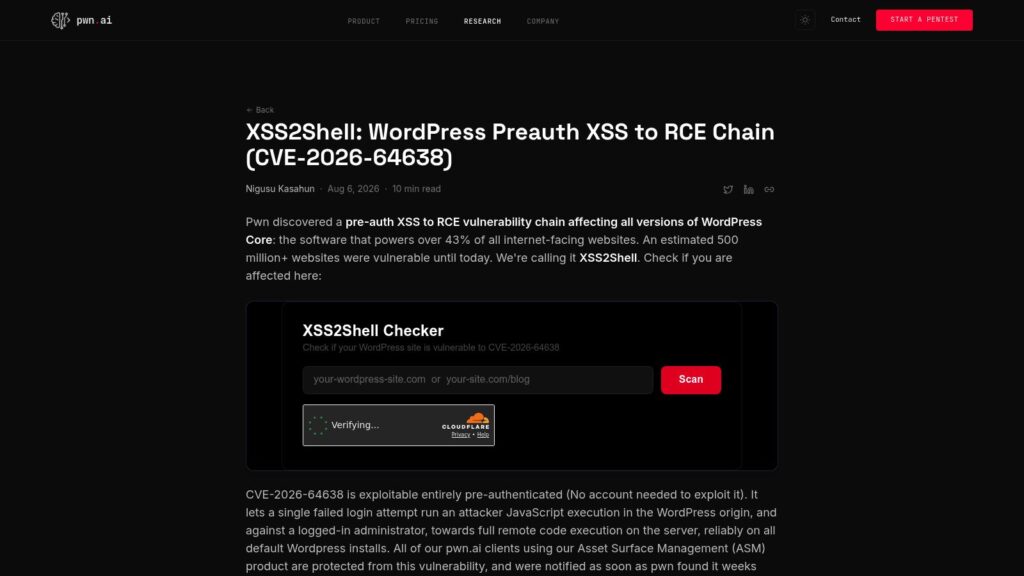
XSS2Shell: WordPress Preauth XSS to RCE Chain (CVE-2026-64638)

Security researchers at pwn.ai disclosed a critical pre-authentication vulnerability in WordPress Core (CVE-2026-64638) that allowed attackers to execute cross-site scripting (XSS) on the login page, leading to remote code execution (RCE) on the server. The exploit abused differences in how WordPress sanitizes HTML, enabling injection of malicious DOM elements that triggered admin-only REST API calls to approve application passwords, publish attacker-controlled scripts, and upload PHP plugins without user interaction. WordPress patched the flaw in version 7.0.3 and backported fixes to all maintained versions; site owners are strongly urged to update immediately.

https://pwn.ai/blog/xss2shell

WordPress Core “Wp2shell” RCE Flaws Get Public Exploits, Patch Now

Critical remote code execution vulnerabilities named “wp2shell” affecting WordPress Core versions 6.9.x and 7.0.x have public exploits released, enabling unauthenticated attackers to fully compromise default installations. The flaws stem from a REST API batch-route confusion bug and an SQL injection in WP_Query, which can be chained for pre-authentication RCE; WordPress has issued emergency updates (6.9.5 and 7.0.2) with forced auto-updates enabled, and administrators are urged to patch immediately or apply temporary mitigations such as blocking REST API access. Cloudflare has also deployed WAF rules to reduce exposure, but these do not replace the need for timely updates as in-the-wild exploitation has already been observed.

https://www.bleepingcomputer.com/news/security/wordpress-core-wp2shell-rce-flaws-get-public-exploits-patch-now/

Scroll to Top